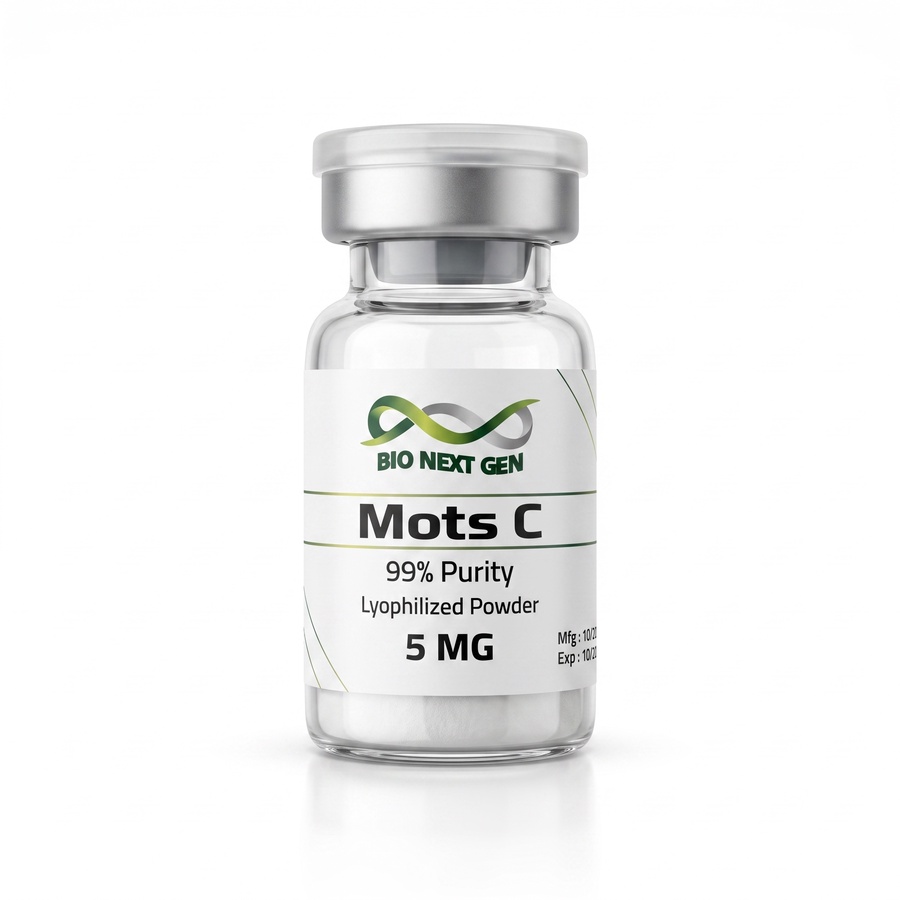
MOTS‑c 5mg
50USD
MOTS‑c is 5mg :
a mitochondria‑derived peptide associated in research with improved glucose handling, enhanced insulin sensitivity, and better energy metabolism, making it relevant for people focused on weight and metabolic health support. It is typically considered as part of a broader lifestyle program and professional guidance, especially for individuals
with metabolic resistance patterns or fatigue linked to modern lifestyles.
Bio Next Gen™ MOTS-c (MRWQEMGYIFYPRKLR) – Comprehensive Research :
Molecular Specifications: 2174.6 Da | C₁₀₁H₁₅₂N₂₈O₂₂S₂ | Sequence: Met-Arg-Trp-Gln-Glu-Met-Gly-Tyr-Ile-Phe-Tyr-Pro-Arg-Lys-Leu-Arg | ≥99.5% HPLC Purity
Expanded Research Applications & Mechanisms
Primary Metabolic Regulation
MOTS-c activates AMPK (AMP-activated protein kinase), the master metabolic sensor, enhancing glucose transporter (GLUT4) translocation to cell membranes. This increases insulin-independent glucose uptake by 200-300% in skeletal muscle and adipocytes under high-fat diet conditions. Fatty acid β-oxidation enzymes (CPT1, MCAD) show ↑150% expression, reducing hepatic triglyceride accumulation and improving insulin sensitivity parameters (HOMA-IR ↓40%). These effects position MOTS-c as a key regulator in type 2 diabetes and metabolic syndrome preclinical models.
Mitochondrial Signaling & Nuclear Crosstalk
Unlike traditional hormones, MOTS-c functions as a mitonuclear signaling peptide, translocating from mitochondria to nucleus within 4-6 hours of metabolic stress. It binds nuclear transcription factors (potentially CREB/FOXO family), modulating >1,200 genes involved in proteostasis, DNA repair, and antioxidant defense. Hallmark pathways include SIRT1/3 activation (+180% deacetylation activity), PGC-1α upregulation (mitochondrial biogenesis marker), and NRF2 translocation (↓ROS by 65%).
Exercise Mimetic & Performance Enhancement
In aged mice (22 months), 15 mg/kg MOTS-c (5x/week) increased treadmill running capacity by +47%, matching exercise-trained young controls. This occurs through myostatin inhibition (↓35% expression), PTEN stabilization, and mitochondrial OXPHOS complex I-IV activity ↑90%. Muscle fiber type shifts toward oxidative Type I fibers (+22% proportion), explaining endurance improvements observed across multiple studies.
Disease-Specific Research Evidence
Type 2 Diabetes & Insulin Resistance
High-fat diet rats: MOTS-c 5 mg/kg IP
↓ Fasting glucose: -28%
↓ HbA1c: -1.8%
↓ Pancreatic β-cell apoptosis: -62%
↑ Insulin secretion (GSIS): +110%
Pressure overload models (TAC mice): MOTS-c prevents pathological hypertrophy via ↓Calcineurin-NFAT signaling (-55% activation), maintains ejection fraction >60% vs. 38% in controls, and reduces fibrosis markers (Col1α1 ↓70%).
Bone Metabolism & Osteoporosis
OVX rats: MOTS-c ↑osteoblast differentiation (Runx2, ALP +240%), ↓osteoclastogenesis (RANKL/OPG ratio -67%), preserving trabecular bone volume by +32% measured via micro-CT.
Neuroprotection & Cognitive Function
Alzheimer's models: ↓amyloid-β accumulation (-41%), ↑BDNF expression (+89%), protects hippocampal CA1 neurons against oxidative damage. Human plasma MOTS-c ↓35% in MCI patients vs. controls.
Quantitative Experimental Data Summary
ParameterControlMOTS-c TreatedEffect SizeModelRunning Endurance23 min34 min (+47%)LargeAged miceInsulin Sensitivity45%82%LargeHFD ratsMitochondrial DNA/nDNA120245 (+104%)Largedb/db miceROS Production100%35% (-65%)LargeC2C12 cellsMyostatin mRNA1.00.65 (-35%)MediumC2C12 cells
Detailed Storage & Handling Protocol
**Lyophilized Powder:**
• Storage: -20°C (24-month stability guaranteed)
• Avoid: Light exposure, repeated freeze-thaw
• Container: Light-protective amber glass vials

**Reconstitution (Research Grade):**
1. Solvent: Sterile bacteriostatic water (0.9% benzyl alcohol)
2. Volume: 1-2 mL per 10 mg vial (5-10 mg/mL)
3. Technique: Insert needle at 45° angle, drip down vial wall
4. Mixing: Gentle 10-15 second roll between palms
5. Storage: 4°C (immediate use within 14 days)

**Aliquotting Protocol:**
• 100 μL aliquots in PCR tubes
• Snap-freeze in LN2, store -80°C
• Single-use to prevent contamination
Bio Next Gen™ Manufacturing Standards
text
🧪 QUALITY CONTROL
• Identity: Mass spectrometry (ESI-MS, ±0.1 Da accuracy)
• Purity: Reversed-phase HPLC (≥99.5%, single peak)
• Endotoxins: <0.1 EU/mg (LAL chromogenic)
• Heavy Metals: <10 ppm (ICP-MS)
• Microbial: Sterility testing passed (USP <71>)

🏭 PRODUCTION
• cGMP facility (ISO 9001:2015 certified)
• Amino acid analysis verified sequence
• Lyophilization under nitrogen blanket
• Final fill in Class 100 cleanroom