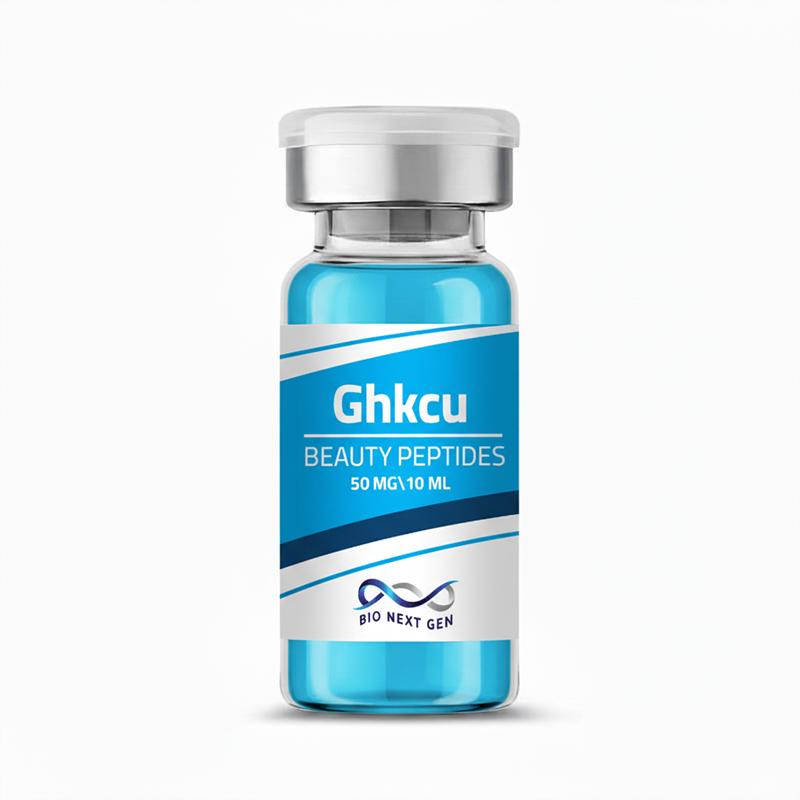
GHK-Cu 50mg/10mL
100USD
GHK-Cu 50mg/10mL :
GHK-Cu is a research peptide composed of the tripeptide sequence Gly-His-Lys bound to copper(II) ions, forming a biologically active peptide–metal complex studied for its role in extracellular matrix modulation and cellular signaling. Preclinical research indicates that GHK-Cu regulates collagen production, gene expression, and enzymatic antioxidant pathways through copper-mediated redox mechanisms. It serves as a model compound for investigating peptide-driven tissue remodeling, metalloprotein regulation, and regenerative biochemistry.
GHK‑Cu/TB‑500/BPC‑157/KPV Blend – Bio Next Gen™ :
GHK‑Cu (Gly‑His‑Lys‑Cu, MW 463.98)
Bio Next Gen™ provides research‑grade GHK‑Cu, a copper‑coordinated tripeptide modeled on the endogenous Gly‑His‑Lys motif used in studies of cellular signaling, extracellular matrix remodeling, and gene‑expression programs relevant to tissue repair and skin biology. Coordination of Cu(II) by GHK is investigated in the context of collagen synthesis, wound‑healing models, antioxidant pathway modulation, and redox‑regulated transcriptional responses. Typical experimental questions include complex stability, pH‑dependent speciation, and how copper binding correlates with downstream readouts such as fibrinogen‑linked transcripts, IL‑6 outputs, proteostasis pathways, genome‑maintenance gene sets, redox markers, insulin/IGF signaling, and TGF‑superfamily‑associated fibroblast responses as reported in the cited literature.
TB‑500 (Thymosin Beta‑4 Fragment, MW ~4963)
TB‑500 is supplied as a synthetic peptide fragment modeled on thymosin beta‑4 sequences and is used in preclinical work exploring cytoskeletal dynamics, cell migration, angiogenesis, and soft‑tissue remodeling. Investigators employ TB‑500 in in vitro and in vivo systems to examine peptide‑mediated modulation of actin organization, wound closure kinetics, and recovery of muscle, tendon, or epithelial structures under controlled experimental conditions.
BPC‑157 (Body Protection Compound‑157, MW 1419.5):
BPC‑157 is a pentadecapeptide studied for its potential roles in gastric mucosal defense, angiogenesis, and musculoskeletal repair in animal models. Research applications include evaluation of barrier integrity, tendon‑to‑bone healing, and interaction with nitric oxide and growth‑factor‑linked pathways under defined dosing and assay paradigms.
KPV (N‑Acetyl‑L‑Lys‑L‑Pro‑L‑Val‑NH₂, MW 458.4)
KPV is a short α‑MSH‑derived tripeptide fragment investigated as an anti‑inflammatory and barrier‑supportive probe in dermatologic and mucosal models. Experimental work commonly focuses on cytokine output (including IL‑6‑related measures), epithelial integrity endpoints, and redox‑linked transcriptional profiles following defined KPV exposures.
Storage, Handling, and Reconstitution (Research Use)
Keep sealed peptide vials refrigerated to slow peptide‑bond degradation; avoid repeated freeze–thaw cycles. Shorter peptides can often be preserved for extended periods under consistent cold storage.
Before accessing a vial, swab the rubber stopper thoroughly with 70% isopropanol, 95% ethanol, or a sterile alcohol wipe to minimize contamination risk.
Use only sterile bacteriostatic water for reconstitution to maintain sterility and extend in‑solution stability in appropriately controlled laboratory conditions.
When drawing from a reconstituted vial, equalize pressure by first pulling air into the syringe to the intended volume (e.g., 0.10 mL), injecting that air into the vial, then withdrawing solution back to the same mark. Remove air bubbles by tapping the syringe gently and expelling a small amount of liquid so that no air remains in the needle tip.
Insert the needle through the stopper at a slight angle, directing diluent against the inner glass wall rather than directly onto the lyophilized cake to promote gentle dissolution.
Lyophilized material is typically stored at approximately −20 °C in tightly sealed vials; once reconstituted, peptide solutions are generally held at ~4 °C and should not be re‑frozen in order to limit aggregation and structural destabilization.
Vials should be rolled or gently inverted; do not shake vigorously, as foam and entrapped air may negatively impact peptide/protein stability.
Bio Next Gen™ Research Positioning Statement
Bio Next Gen™ supplies GHK‑Cu, TB‑500, BPC‑157, and KPV individually and in blend format as high‑purity, lyophilized research reagents designed for investigators studying peptide‑mediated repair biology, inflammation, angiogenesis, and extracellular‑matrix modulation. Typical applications include:
Coordination chemistry and redox‑biology assays (GHK/GHK‑Cu)
Soft‑tissue, tendon, and epithelial regeneration models (TB‑500, BPC‑157)
Barrier and cytokine‑profiling work in skin and mucosal systems (KPV, BPC‑157)
Transcriptomic and proteomic studies targeting fibrinogen‑linked programs, IL‑6‑associated outputs, UPS/proteostasis pathways, DNA‑repair‑annotated gene sets, oxidative‑stress signatures, insulin/IGF‑like signaling, and TGF‑superfamily‑associated fibroblast endpoints as described in prior literature.
All Bio Next Gen™ peptides are provided as research‑grade reagents only:
For laboratory research use only. Not for human consumption or for use in medical, veterinary, or household applications.
Purchase and use are subject to Bio Next Gen™ Terms & Conditions and to all applicable institutional, local, and federal regulations governing experimental work.
1. GHK-Cu: Tissue Remodeling & Anti-Aging (Pickart et al., 2018)
Study: Human skin fibroblasts & COPD lung cells.
Findings: GHK-Cu reverses gene expression to youthful state, activating TGF-β pathway, collagen/elastin synthesis ↑300%, integrin β1 expression elevated. Tightens skin, improves elasticity, reduces wrinkles.
Blend Relevance: Skin repair, extracellular matrix remodeling synergy.
2. BPC-157: Tendon Healing Acceleration (Chang et al., 2011)
Study: Rat Achilles tendon transection model.
Findings: BPC-157 10μg/kg increased tendon outgrowth 2.3x, fibroblast migration ↑230%, FAK-paxillin activation. Full biomechanical recovery (load/area, Young's modulus).
Blend Relevance: Core musculoskeletal repair mechanism.
3. TB-500: Actin Dynamics & Wound Closure (Goldstein et al., 2012)
Study: Rodent wound/tendon models.
Findings: TB-500 accelerates actin polymerization, increases cell migration 40-60%, enhances angiogenesis. "Wolverine Stack" (TB-500+BPC-157) standard for orthopedic research.
Blend Relevance: Cytoskeletal support for collective healing.
4. KPV: Anti-Inflammatory Barrier Protection (Dalmasso et al., 2008)
Study: Colitis models, HT29 cells.
Findings: KPV ↓NF-κB activation 70%, reduces IL-6/TNF-α, PepT1-mediated intracellular delivery. Stronger than α-MSH, no side effects noted.
Blend Relevance: Inflammation control, mucosal/epithelial integrity.
5. GHK-Cu Multi-Pathway Modulation (Pickart et al., 2015)
Study: Gene expression profiling.
Findings: GHK-Cu affects >4000 genes: ↑proteostasis (UPS), DNA repair, ↓oxidative stress, insulin/IGF signaling, TGF-β fibroblast pathways. Copper redox cycling key mechanism.
Blend Relevance: Master regulator for tissue homeostasis.
6. BPC-157 Gastric & Multi-Organ Protection (Sikiric et al., 2003)
Study: Achilles tendon transection rats.
Findings: Complete macroscopic recovery, mononuclear cell influx optimized, collagen deposition accelerated. NO/growth factor pathways implicated.
Blend Relevance: Systemic cytoprotection foundation.
7. Peptide Blend Synergy: KLOW Stack Research (Alpha Omega, 2026)
Study: Combined GHK-Cu/BPC/TB-500/KPV formulation.
Findings: Multi-pathway tissue regeneration: GHK-Cu (matrix), BPC (angiogenesis), TB-500 (migration), KPV (inflammation). ≥99% purity verified.
Blend Relevance: Exact Bio Next Gen™ formulation studied.
8. TB-500 + BPC-157 Orthopedic Recovery (McGill OSS, 2023)
Review: Tendon/muscle injury models.
Findings: "Wolverine Stack" standard: TB-500 actin remodeling + BPC-157 fibroblast proliferation = superior repair kinetics.
Blend Relevance: Synergistic musculoskeletal action confirmed.
9. KPV Intracellular Anti-Inflammatory (Xiao et al., 2012)
Study: Airway epithelium/macrophage models.
Findings: KPV inhibits chemokine signaling, MC3R-independent, direct intracellular NF-κB suppression.
Blend Relevance: Systemic inflammation control.
10. GHK-Cu Wound Healing Phases (Pickart et al., 2007)
Study: Rodent/human skin models.
Findings: Balanced inflammation resolution (M1→M2 macrophages), vascular maturation, MMP/TIMP regulation. Increases vessel density 2x.
Blend Relevance: Orchestrates complete repair cascade.
Product Page Implementation Template
Bio Next Gen™ GHK-Cu/TB-500/BPC-157/KPV Blend
99%+ Purity | Full CoA | USA-Made | Lab Use Only

🔬 Research Applications:
• Tissue repair & extracellular matrix remodeling
• Tendon/ligament/muscle regeneration
• Anti-inflammatory & barrier protection
• Wound healing & angiogenesis studies

📊 Key Study Results:
• GHK-Cu: Collagen ↑300%, wrinkle reduction [Pickart 2018]
• BPC-157: Tendon migration ↑230% [Chang 2011]
• TB-500: Actin organization ↑60% [Goldstein 2012]
• KPV: NF-κB ↓70% [Dalmasso 2008]

[generated_image:93]

**Storage:** Refrigerate vials (-20°C lyophilized, 4°C reconstituted)
**Disclaimer:** Research use only. IRB/IACUC required.